
Project Spotlight: Immersive Avatar Customization
What happens when we take an interface designed for a flat screen and place it in an immersive virtual world?
This year, Ryan Andersen (Games MEAE, 2026) and Kaylee Lai (Games BS, 2026) embarked on a foundational project examining user experience and performance during avatar customization. Specifically, we wanted to understand how a user experienced and interacted with an avatar customization interface designed for a traditional 2D display when it was ported into a virtual reality environment. Why? Because many immersive interfaces are designed just like those made for console, desktop, and mobile experiences, and research shows that this design decision doesn’t always translate well.
Avatar customization is richly embedded in many virtual worlds, and it’s often a prerequisite to entering a virtual space. It’s an experience that some users take seriously - and sometimes sink hours into - as avatars serve as one’s body representation and personal identity in a virtual world. While avatar customization may appear trivial, research suggests otherwise. In immersive environments, avatars influence how users communicate, behave, and interact with others (ever heard of the Proteus Effect?). The way users create and represent themselves can have meaningful effects on social experiences, engagement, and even feelings of presence. Therefore, the tools we use to create them and how they’re designed is critical.
In a preliminary study we published at the 2026 IEEE Conference on Virtual Reality and 3D User Interfaces (IEEE VR), we looked at how users customized avatars to match target images when using the same interface design on tablet and virtual reality devices. What we found backed up the research - users interacted differently with the customization interface depending on the device used, suggesting that the same interface design may encourage different behaviors when experienced immersively.
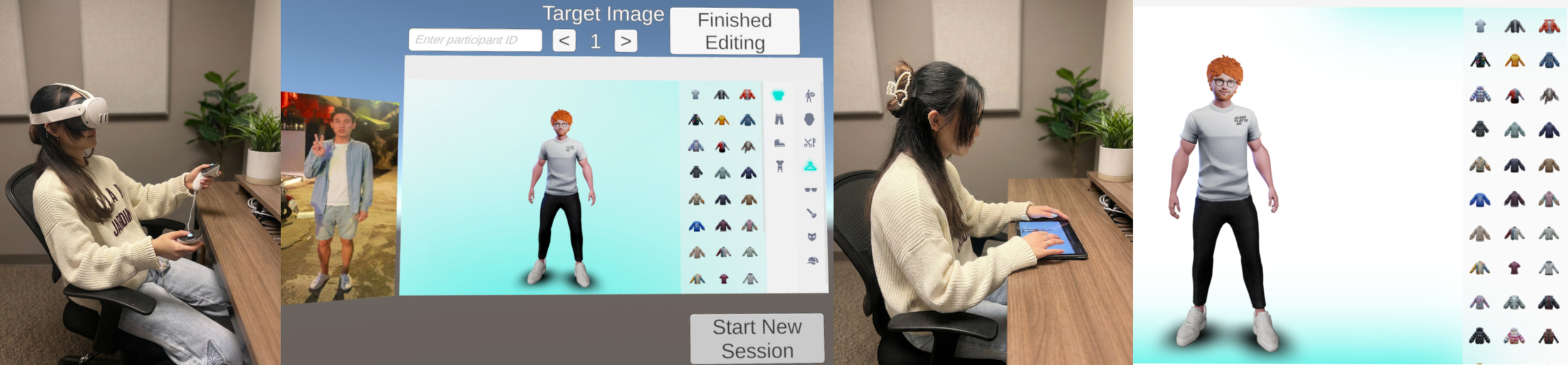
A user interacting with the avatar customization interface deployed in this study. The left two images depict a participant interacting with the VR interface and the right two images a participant using the tablet interface.
Want to read about this study in depth? Our poster publication can be accessed here: 10.1109/VRW70859.2026.00216
Kaylee Lai presented this work at the 2026 IEEE Conference on Virtual Reality and 3D User Interfaces in Daegu, Korea, and at the 2026 Undergraduate Research Symposium at the University of Utah, where she won the Best Poster in STEM Honorable Mention.
Ryan and Kaylee are currently conducting a larger-scale user study aimed at developing evidence-based design recommendations for avatar customization in immersive environments. Their goal is to help establish a roadmap for designing customization systems that are intuitive, efficient, and engaging for future virtual worlds.
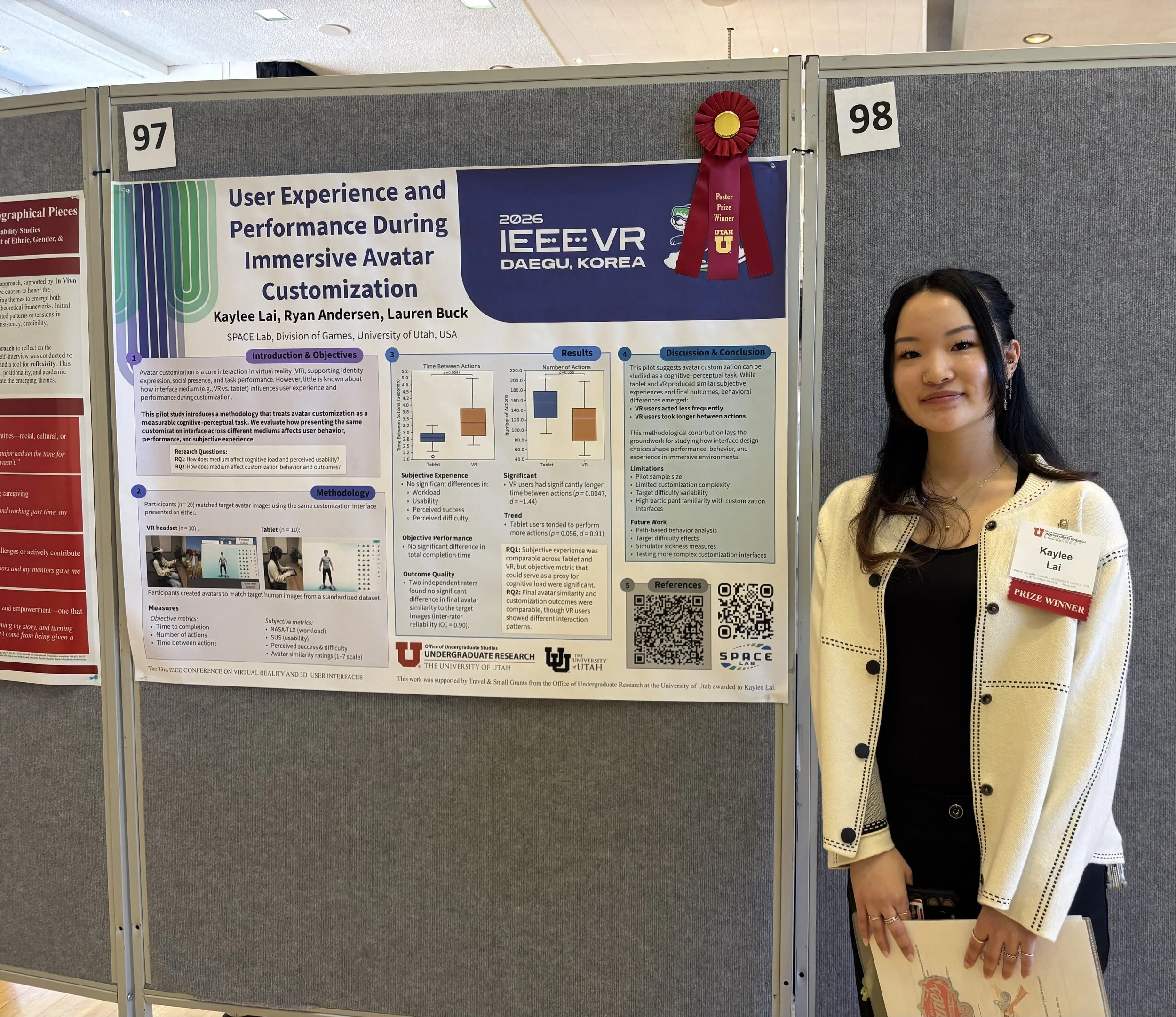
Kaylee Lai presenting our poster at the 2026 Undergraduate Research Symposium.
